
A Complete Compliance Guide
Fiscalization in Germany is the legal duty to record every sale through a certified Technical Security System (TSE). It affects any business or POS software provider that runs an electronic cash register in the country. The governing law is the Cash Register Security Ordinance (KassenSichV), in force since January 2020.
What Is Fiscalization in Germany?
German fiscalization exists to stop tax fraud through tamper-proof transaction recording, not just paperwork. The core duty is the Einzelaufzeichnungspflicht (individual recording obligation). Every business transaction must be recorded separately, completely, and in a form that cannot be changed later.
The tax this protects is VAT, known in Germany as Mehrwertsteuer (MwSt). Accurate sales records mean accurate VAT.
Germany is a “hybrid” fiscal country. It allows both hardware and cloud-based TSE solutions. This makes it more flexible than most European fiscal countries, but harder to implement.
The 2016 Cash Register Act added § 146a AO to the German Fiscal Code. This section requires TSE-equipped systems. The BMF (Federal Ministry of Finance) then issued KassenSichV with the technical detail, and enforcement began in January 2020. For a first orientation, see a Fiscalization Essentials Session.
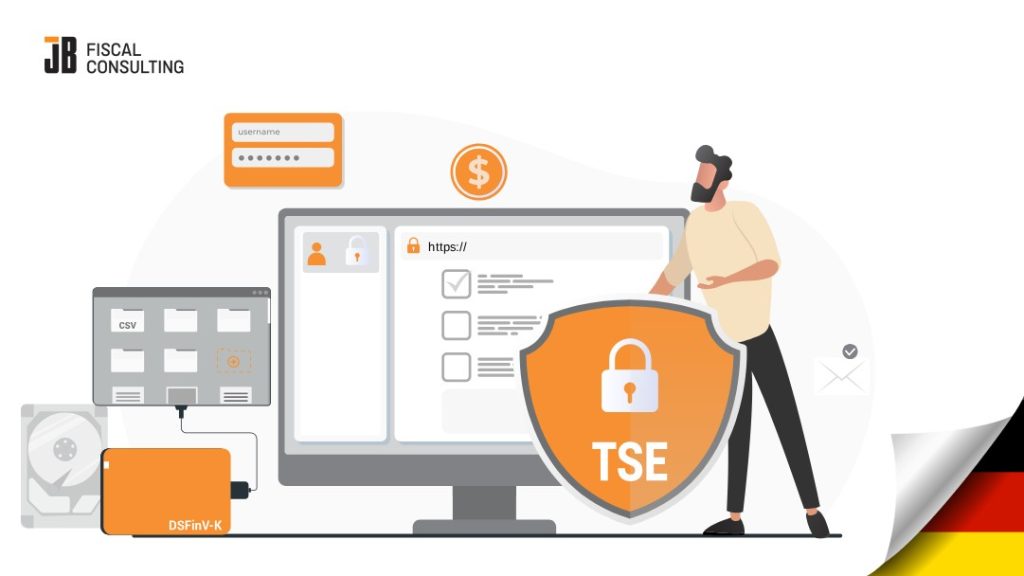
KassenSichV Requirements: What Your POS System Must Do
KassenSichV sets clear duties for every electronic recording system. Your software must meet them all.
- Individual recording: log every transaction separately.
- TSE: use a module certified by the BSI (Federal Office for Information Security). Each TSE has three parts – a security module (Sicherheitsmodul), a storage medium (Speichermedium), and a standard digital interface (Einheitliche Digitale Schnittstelle).
- Transaction signing: give each transaction a cryptographic signature. These signatures form an unbroken chain that auditors can verify.
- DSFinV-K export: export all transaction data in DSFinV-K format (Digital Interface of the Tax Administration for Cash Register Systems). Keep the TSE TAR file too – a separate audit artefact, not the same as the DSFinV-K export.
- Receipt obligation: issue a receipt for every transaction, on paper or as a digital receipt. Each receipt needs the required fields (Beleg-Mindestangaben): date, time, transaction number, amount, payment type, and the TSE signature or QR code.
- Cash register reporting: report every system through Mein ELSTER.
- GoBD archiving: keep fiscal data for 10 to 15 years. Maintain a process record called the Verfahrensdokumentation.
One point matters most for developers: KassenSichV applies to all payment methods. Cash, card, QR code, and voucher sales all fall under it. For a scope question about your own architecture, book a Consulting Session.
Hardware TSE or Cloud TSE – Choosing the Right Architecture
Germany permits both hardware and cloud TSE – unusual in Europe.
Hardware TSE uses a physical module built into the cash register. Common providers include Swissbit, Epson, and Diebold-Nixdorf. It suits fixed tills.
Cloud TSE is a hosted service. It fits mobile POS and multi-location chains. It is not automatically the better choice. Each option carries its own technical limits, so match the architecture to your deployment. Fiscal middleware – the software layer between POS and TSE – must link to a certified module either way.
Both types must be BSI-certified against the BSI technical guidelines TR-03153, TR-03151, and TR-03116. No TSE is legal without BSI certification. Check certified devices on the BSI website.
Large stores often run connected systems (Verbundsysteme), where several registers share one TSE under rules that differ from single-till setups.
Plan for TSE failure (Ausfall) too. German rules require a documented failure procedure. A TSE outage does not pause your duty to record sales.
The 2025 Cash Register Reporting Obligation
Since 2025, businesses must report their cash registers:
- Log in to Mein ELSTER, or use the ERiC interface for automated submission.
- Report each electronic recording system and its TSE with an Anmeldung (registration).
- Report retired systems with an Abmeldung (deregistration). Fix mistakes with a Korrektur (correction).
- Report each business location (Betriebsstätte) on its own.
Systems bought before 1 July 2025 had to be reported by 31 July 2025. Two authorities sit behind this process. The local Finanzamt (tax office) handles day-to-day contact. The Bundeszentralamt für Steuern (BZSt), the Federal Central Tax Office, provides national oversight.
Tax Audits and Enforcement: What German Authorities Check
Enforcement in Germany is active, technical, and often unannounced.
§ 146b AO allows a Kassen-Nachschau – an unannounced, warrantless on-site cash register inspection. Auditors need not open a formal audit first.
During an inspection, they may ask for three things: the DSFinV-K export, the TSE TAR file, and the Verfahrensdokumentation. Auditors run the DSFinV-K export through IDEA audit software. It flags gaps in the transaction chain and inconsistent data.
Under § 147 AO, authorities may also access digital records during audits. This relies on full GoBD retention and a working internal control system.
Authorities also rely on the AEAO zu § 146a AO, the BMF’s interpretive decree. It explains how § 146a AO works in practice, beyond the plain text of the law.
Additional Compliance Obligations Linked to KassenSichV
First, cancellations and voids. Refunds, voids, and cancellations must each be signed by the TSE and recorded as a Vorgang (procedure); you cannot delete them. KassenSichV separates business transactions (Geschäftsvorfälle) from other procedures (andere Vorgänge) such as training mode and end-of-day reports. Your system must classify each one correctly.
Second, e-invoicing. XRechnung and ZUGFeRD are B2B invoice formats under a separate legal framework. POS and ERP systems may need to support both.
Third, product liability. Selling non-compliant POS hardware or software is prohibited. Liability falls on the manufacturer, not only the end user.
A VAT reform is also under discussion in Germany. Its status is not yet settled, so treat it as a monitoring item for now. KassenSichV changes often. Regulatory Monitoring tracks Germany within JB Fiscal Consulting’s 45+ country portfolio, and the Germany Consulting Session covers DSFinV-K, TSE options, and other fiscalization rules in full.
Frequently Asked Questions
Does KassenSichV apply to card payments only, or to all payment methods?
KassenSichV applies to all payment methods — cash, card, QR code, voucher, and any other form. A common misconception is that only cash transactions need a TSE. The obligation is triggered by the transaction itself, not the payment method. However, the TSE obligation is related to systems which have a “cash register function”, meaning that they can process cash payments. If the system can process only non-cash payment media, TSE is not mandatory.
What is the difference between the DSFinV-K export and the TSE TAR file?
Both are required during a tax audit, but they serve different purposes. The DSFinV-K export is a structured data file. It holds all transaction records in the format the tax authority analyses for gaps. The TSE TAR file is the raw signed log produced by the TSE itself. It proves that each transaction signature came from a certified device and has not been altered. Auditors may request both independently.
Which business transactions are affected by German fiscalization?
Those are all legal and economic transactions that document or influence or change the profit or loss or the composition of assets in a company over a certain period of time. As soon as a business transaction is started it must be recorded by the TSE.
Do we need to replace our existing cash registers?
Not necessarily. You may keep existing hardware if it can connect to a certified TSE — hardware or cloud. Your POS software must be updated to implement transaction recording, DSFinV-K export, and the receipt fields required by KassenSichV. Confirm TSE compatibility with your hardware supplier before you assume existing devices are sufficient.
What happens if our TSE fails during trading hours?
German regulations require a documented procedure for TSE failure (Ausfall). During an outage, transactions must still be recorded by POS and receipts marked accordingly. The Verfahrensdokumentation must describe this procedure. A TSE failure does not suspend the obligation to record.
What is a cash register closing?
The cash register closing is the aggregating summary of a cash register for all individual movements with the transaction type “document” (business transaction) for a specific period. As a result, only business transactions that are relevant for sales tax and/or income tax processing are aggregated. The cash register closing is created once or several times a day or even across calendar days for a cash register.
We are a global retailer entering Germany. Do we need a local partner?
JB Fiscal Consulting recommends seeking expert guidance before deployment. The AEAO zu § 146a AO contains interpretive guidance not always visible in the law itself. The Kassen-Nachschau provisions mean audits can begin immediately after go-live. The Verfahrensdokumentation is a deliverable that must be in place before the first transaction. Contact JB Fiscal Consulting for a Consulting Session or On-going support.
Do you have to use exactly one TSE per cash register?
No. Several cash registers can be connected to one TSE.
Can the cash register data (to generate the DSFinV-K export) be saved in the cloud?
Yes. However, it must be ensured that the data can be made available at any time for audit purposes as part of an external audit or review in a narrow time context.
Does a system that basically only allows non-cash sales (e.g. a webshop or an online pre-order system that requires a cashless advance payment) need a TSE?
No. Only systems with a “cash register function” fall under the TSE obligation.
German fiscalization rewards early, careful preparation. KassenSichV, the TSE, and the 2025 reporting obligation each carry technical and legal detail. Getting fiscalization in Germany right before go-live is far cheaper than fixing it during an audit. Independent guidance helps you plan it correctly the first time.
JB Fiscal Consulting offers Consulting Sessions, Fiscalization Essentials Sessions, Regulatory Monitoring, and Ongoing Support for businesses. Contact us at office@jbfiscalconsulting.com or visit jbfiscalconsulting.com to discuss your compliance situation.
Phone: +381 62 420 541 Monday – Friday, 09:00 – 17:00 CET
| Disclaimer: The information on this page does not constitute legal advice. JB Fiscal Consulting cannot be held responsible for errors or omissions. Please contact us if you have specific questions about your compliance situation. |